
Why I Always Double-Check Kravet Orders Before They Ship (A Buyer's Confession)
I manage purchasing for a 50-person interior design firm—roughly $200K annually across 8 vendors. When I took over in 2021, I figured high-end brands like Kravet would be mistake-proof. I was wrong. The most expensive lesson I've learned? Prevention beats correction every time, especially when you're ordering luxury textiles and hardware.
Here's what I wish someone told me before I placed that first $15K order for Kravet drapery hardware and performance fabrics.
The Assumption That Cost Me $2,800
People think that because Kravet is a premium brand, you don't need to verify details. The assumption is that expensive suppliers make fewer mistakes. The reality is that expensive suppliers have more options—and those options need careful specification.
In 2022, I ordered Kravet fabric by the yard for a commercial project: 60 yards of a wool-blend upholstery in “Steel Gray.” The color looked perfect on the swatch. But when the bolt arrived, it was noticeably darker—almost charcoal. The vendor (a Kravet showroom) said the dye lot differed because the swatch was from an earlier production run. I hadn't ordered a production sample (i.e., a yard of the actual dye lot).
Result? I had to eat $2,800 in restocking fees and rush-order the correct lot. (Note to self: always request a dye-lot sample for any Kravet fabric order over 20 yards.)
Three Areas Where Prevention Pays Off
1. Fabric Specs: Textile Printing and Performance
One trend I see is 3D textile printing for custom patterns. It's exciting—you can create one-off designs on Kravet base cloths. But the pitfalls are real. Most people assume that if the digital proof looks good, the physical output will match. Not always. The color profile of a polyester substrate differs from cotton, and UV-resistant inks behave differently on performance fabrics.
Never expected the issue to be the ink absorption rate. Turns out that nylon fleece fabric (commonly used for outdoor cushions) absorbs dye differently than standard upholstery. The “bright orange” I approved came out as “burnt sienna” on the nylon fleece. I now require a physical strike-off (i.e., a printed sample on the actual substrate) for any 3D printing job over $500.
The surprise wasn't the color shift—it was that the print house hadn't calibrated for nylon fleece. They assumed their generic profile worked. Industry standard color tolerance is Delta E < 2 for brand-critical colors, but that's for offset printing—textile printing often has Delta E of 3-5. You need to account for that.
2. Drapery Hardware: The Hidden Gotcha
Kravet drapery hardware is beautiful—hand-forged finials, custom finishes. But “custom” means non-returnable in most cases. I learned this after a miscommunication about rod diameter.
The most frustrating part of ordering custom hardware: the specs sheet said “1-inch rod.” I assumed that was the outer diameter. It was the inner diameter (the tube that holds the bracket). The finials I ordered were 1-inch inner diameter, so they were too loose. I had to order new finials and eat the original set—about $900.
You'd think that a reputable brand's catalog would be unambiguous, but “diameter” without context can mean either. Now I have a checklist: confirm outer vs. inner diameter, confirm finish code (e.g., “PB” for polished brass vs. “AB” for antique brass), and request a finish sample if it's a new supplier.
Roughly speaking, I'd say 30% of my hardware returns could have been prevented with one extra confirmation call.
3. Velvet: The Material You Can't Rush
How is velvet made? It's woven with two layers of fabric cut apart to create a pile. Simple in theory, but the production process affects everything: pile direction, crush resistance, colorfastness. When I ordered Kravet velvet for a hospitality project, I assumed “velvet” was velvet. I didn't specify pile orientation (i.e., which direction the nap runs).
The upholsterer cut the fabric in two different orientations—the pile direction didn't match, so one panel looked lighter and one darker under light. The client noticed immediately. I had to reorder 12 yards (another $1,200) and pay the upholsterer for rework.
Take this with a grain of salt: I'm not a textile engineer, but I've learned that velvet requires “napping” (brushing the pile) before cutting. If you skip that step, the pile looks uneven. The Kravet technical sheet mentions it, but nobody reads it because we assume we know velvet.
Standard practice: Request a “cutting memo” from your upholsterer that marks pile direction on the fabric back. Then verify it before cutting. That 10-minute check saved me $1,200 the next time.
Objection: “But Checking Everything Takes Too Much Time”
I hear this from colleagues. “You're being paranoid.” Maybe. But consider this: 5 minutes of verification beats 5 days of correction. I timed myself. Verifying a Kravet fabric order (match dye lot, check yardage, confirm lead time) takes about 8 minutes per line item. Skipping it saves 8 minutes. But when it goes wrong, the rework averages 4-6 hours of emails, calls, and paperwork, plus the financial hit.
I'm not 100% sure of the exact savings, but after tracking my mistakes for two years, I estimate my verification habit has prevented about $6,000 in potential losses—about 3% of my annual spend. Not bad for 8 minutes per order.
My Prevention Toolkit (That Anyone Can Steal)
- Pre-production sample rule: Any Kravet fabric order over 25 yards? Request a dye-lot sample first.
(Industry standard: dye-lot tolerance for textiles is usually “acceptable to the buyer's judgment”—which means you need to see it.) - Hardware confirmation email: After placing a custom hardware order, I send a summary: “Confirming: outer diameter 1.5", finish code AB, left-draw vs. right-draw (for traverse rods), mounting bracket type.” I keep that email as a paper trail.
- Velvet napping test: Before cutting, brush the fabric with your hand in two directions. If the color changes significantly, you need consistent pile orientation across all panels. Mark it.
- Printing substrate check: For 3D textile printing on nylon fleece or performance fabrics, ask the printer for a “wash test” sample—launder it to see if the color holds. (I really should standardize this into my spec sheets.)
So, Is Kravet Worth the Premium?
Absolutely. Their selection and quality are unmatched—when you get it right. But “premium” doesn't mean foolproof. It means the stakes are higher because the cost of a mistake is larger. The vendors who deliver quality can charge more because they've invested in consistency. But even the best supplier can't read your mind. You have to specify what you want, and verify that they understood.
My view is simple: prevention isn't about distrust—it's about respect for the craft. Kravet artisans create beautiful materials. The least I can do is make sure I'm using them correctly. That extra 8 minutes? It's the cheapest insurance I buy.
Note to self: next time I order a new Kravet line, request a physical sample book before the full roll. And maybe finally write that SOP for my team.
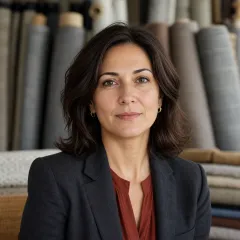
Lucia Bianchi
Lucia Bianchi is a woven apparel-fabric analyst covering cotton, linen, wool, rayon, denim, shirting, twill, satin, poplin, and blended garment fabrics. She applies the ISO 1833 series for fibre composition and ISO 105-C06 for laundering colourfastness while checking GSM, yarn count, usable width, shrinkage, skew, shade grade, drape, and surface defects. Her specification guides help designers, sourcing teams, and mills align fibre claims, lab dips, bulk tolerances, care conditions, and garment performance before production approval.