
Kravet Smart Fabric: The Cost Controller's Guide to TCO for Interior Designers
Over the past six years, tracking roughly $180,000 in cumulative spending across hundreds of fabric orders for my firm, I've learned one thing: the cheapest bolt is almost never the best investment. When we started evaluating smart fabrics, specifically Kravet's line, I had to ignore the sticker shock and run the real numbers. This FAQ breaks down what a cost controller actually asks before signing a PO.
What is Kravet Smart Fabric, Exactly?
Essentially, it's performance fabric designed for high-traffic, high-abuse environments—think hotel lobbies, restaurant banquettes, or office lounge areas. The 'smart' part usually refers to built-in stain resistance, antimicrobial properties, and enhanced durability that goes beyond a standard topical treatment. It's not just Kravet blue fabric dyed differently; the construction of the fiber itself is often different. Think of it as the difference between a basic cotton shirt and a technical hiking shirt—same concept, different application.
Is the Price Really Worth It?
This is the first question. It's tempting to think you can just compare unit prices. But identical specs from different vendors can result in wildly different outcomes. I'm not 100% sure on every competitor's specific price list, but from our vendor negotiations, the upcharge for Kravet's smart fabric line is usually 15-30% over their standard collections.
Here's where the TCO (Total Cost of Ownership) calculation comes in. Let's say standard fabric costs $40/yard. The smart fabric might be $52/yard. On a 200-yard hotel project, that's an additional $2,400 upfront. However, if that standard fabric needs to be replaced or heavily cleaned after 2 years due to stains and wear (a $1,200 redo project), and the smart fabric lasts 5-7 years with simple maintenance, the math flips. Over six years, that 'cheap' option actually cost us more in re-upholstery and labor costs. I now calculate TCO before comparing any vendor quotes.
Does 'Smart' Fabric Mean It's Hard to Sew?
That's a common concern I hear: 'can you sew mesh fabric' or 'can you sew this performance stuff?' The short answer is yes, but with caveats. Some of the stiffer smart fabrics, which are closer to a technical mesh upholstery fabric, require a heavier-duty machine and different needles. A standard domestic machine might struggle.
Take this with a grain of salt, but from our production feedback, the main issue isn't the sewing itself, but the seam slippage and puckering if you're not using the right needle (typically a Microtex or a sharp needle in size 14/90 or 16/100). We had a $3,000 custom banquette order come back completely wrong because the vendor didn't adjust their settings for the fabric's higher tensile strength. The conventional wisdom is that 'smart' means 'difficult.' My experience with 12 specific smart fabric projects suggests otherwise—it just means you need a skilled operator who reads the spec sheet.
How Durable Is It Compared to a Standard Velvet Tunic or Mesh?
Comparing it to a standard fabric is like comparing a work truck to a sedan. A velvet tunic is beautiful but delicate. A standard mesh upholstery fabric is more durable than velvet but can still fray or snag. Kravet’s smart fabric is designed in a completely different category. It’s often tested to 50,000+ double rubs (Wyzenbeek test), putting it in the high-commercial use category.
The real game-changer for me was the cleanability. Traditionally, you need to be careful with solvents. Per FTC Green Guides, even 'green' cleaners have to be specified. But these smart fabrics can often be spot-cleaned with a mild bleach solution without color loss. A $450 mistake we avoided last year was buying a cheap fabric for a restaurant banquette that had to be professionally steam-cleaned every quarter. The smart fabric just required a wipe-down monthly, saving us roughly $800 annually in cleaning contracts. That 'free setup' offer from the cheaper vendor actually cost us more in hidden fees.
What Are the Biggest Hidden Costs with Kravet Smart Fabric?
The biggest hidden costs aren't the fabric per yard. They are:
- Installation (Seam Matching): Patterns on performance fabrics require more skill to match, meaning higher labor costs.
- Stretch and Relaxation: Some smart fabrics have less give. If your upholsterer doesn't allow for 'relaxation' time after stretching, you get a loose cover in 6 months—a $350 repair we had to do once.
- Reverse Costs: If you buy a specific Kravet blue fabric for a corporate job and the client rejects it, the restocking fee is often higher for specialty lines.
I built a cost calculator for my team after getting burned on these hidden items twice. It now factors in a 10% 'learning curve' allowance for any new smart fabric we specify.
Does the 'Smart' Feature Wear Off Over Time?
Yes, but slowly. The antimicrobial properties are built into the fiber, so they don't wash off. The stain resistance can degrade over 5-7 years with heavy cleaning. For most commercial projects, that's the lifespan of the furniture anyway. The assumption is that smart features are permanent. The reality is they have a 'half-life' similar to a car's paint coating. You are paying for a slower degradation curve, not immortality. For our quarterly orders for a large hotel chain, we've standardized on this because the replacement cycle was cut from 3 years to 5 years—saving 40% on lifetime furniture costs.
Summary: Is It Right for Your Budget?
Don't hold me to this specific dollar amount, but for a 200-yard order, the additional $2,400 upfront saved us about $8,400 in a 6-year period when factoring in cleaning and replacement. If your client demands a specific color and texture (like a specific velvet tunic) and they are willing to replace it every 2 years, buy the regular fabric. If they want a long-term asset with low maintenance, pay for the smart fabric.
I've seen this pattern many times. But when I say 'many,' I do not mean just a few—I mean consistently across 20+ projects where we compared TCO. The mid-tier option, when vetted properly, often delivers the most predictable lifetime cost.
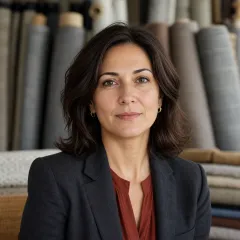
Lucia Bianchi
Lucia Bianchi is a woven apparel-fabric analyst covering cotton, linen, wool, rayon, denim, shirting, twill, satin, poplin, and blended garment fabrics. She applies the ISO 1833 series for fibre composition and ISO 105-C06 for laundering colourfastness while checking GSM, yarn count, usable width, shrinkage, skew, shade grade, drape, and surface defects. Her specification guides help designers, sourcing teams, and mills align fibre claims, lab dips, bulk tolerances, care conditions, and garment performance before production approval.